
ALCOA SOUTH PLANT PURCHASE GHOST RESOLUTION HAUNTS BLOUNT COUNTY COMMISSION: PROCEDURAL CHAOS REVEALS FLAGRANT DISREGARD FOR RULES
MARYVILLE – Questions are mounting at the Blount County Courthouse following a series of procedural failures on July 9, 2026, that saw a “ghost” resolution—one with no identifiable author or sponsor—infiltrate the agendas of both the Budget Committee and the County Commission Workshop. The day’s events have exposed a systemic breakdown in leadership, with the County Clerk and key Chairpeople accused of ignoring the very rules they are sworn to uphold. It is rumored that the resolution was not written by a commissioner but by people working for the Mayor and Brian Daniels of the Industrial Development Board. Neither the Mayor nor Brian Daniels can sponsor a resolution. That authority is reserved solely for the elected Commissioners.
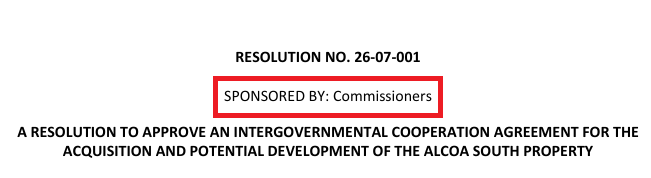
The Mystery of the Anonymous Resolution
The central question remaining is: Where did this resolution come from? Under the Blount County Board of Commissioners’ Rules of Procedure, an anonymous resolution should be a physical impossibility.
Rule 6A is explicit: “Any proposed resolution may be introduced only by a member of the Board, and the Clerk or Chairman shall not receive or file any resolution that is not reduced to writing by the sponsor(s) of the resolution”. By placing an unsponsored resolution on two separate agendas, the County Clerk’s office committed a fundamental error, violating the mandate that the Clerk should not even “receive or file” such a document unless a sponsor has physically produced it. Furthermore, Rule 6A dictates that identification numbers are assigned only “after receipt of the written resolution” from a sponsor. If there were no sponsors, the resolution should never have had a control number or a place on a public agenda.
Chairpeople Fail to Hold the Line
The failure did not stop at the Clerk’s desk. Budget Committee Chairperson Mayor Ed Mitchell and Commission Workshop Chairperson Nick Bright both failed in their duty to “preserve order and decorum” and “decide questions of order” as required by Rule 13E.
Mayor Mitchell, presiding over the Budget Committee, went so far as to ask for a motion to discuss and vote on a document that was legally invisible under the rules. Rule 6B states clearly that any resolution “must have two (2) sponsors’ names on the heading of the resolution or signatures of said sponsors before debate or vote is allowed“. By entertaining a motion from Commissioner Mike Caylor on a resolution lacking these names, Mitchell bypassed a mandatory prerequisite for committee action. The Mayor had the responsibility to rule the resolution out of order and remove it from the Budget Committee agenda. He did not. Instead, the County Clerk doubled down and added the resolution to the Commission Workshop agenda in the hour gap between the two July 9th meetings.
Akard and King: A “Bastardization” of Sponsorship
Commission Workshop chairperson, Nick Bright, also had a responsibility to rule the resolution out of order and have it removed from the agenda. He did not.
The most egregious display of procedural gymnastics occurred during the Commission Workshop. When Chairperson Nick Bright announced the resolution lacked sponsors, Pro Industrial Development Board Commissioners Mike Akard and Scott King “stepped up” to claim the resolution as their own.
This move has been slammed as a total bastardization of Rule 6A. The rules do not allow commissioners to simply “adopt” a mystery document on the floor to save it from being ruled out of order. Rule 6A requires that the resolution be “reduced to writing by the sponsor(s)” and submitted to the Clerk “one calendar week prior to the date of the meeting“.
By claiming sponsorship of a document they did not write or submit by the deadline, Akard and King effectively skirted the transparency requirements intended to ensure resolutions are vetted and attributed to specific members before they reach the public eye. Their actions ignored the requirement that “all resolutions must have all necessary supporting documentation attached prior to inclusion in the agenda“.
A Pattern of Violations
The day’s events suggest a troubling “fix-it-on-the-fly” culture that contradicts the formal structure of the Board:
- The Clerk violated Rule 6A by filing and numbering a resolution not submitted in writing by a sponsor.
- Mayor Mitchell violated Rule 6B by allowing a motion on a resolution that lacked the mandatory two sponsors on its heading.
- Commissioners Akard and King mocked the intent of Rule 6A, claiming authorship of a document that appeared out of thin air, bypassing the one-week submission deadline and the requirement that sponsors actually be the ones to “reduce to writing” the proposals they bring forward.
As the resolution moves forward, the question remains: if the rules can be ignored for the sake of convenience, what is the purpose of having them at all? For now, the “ghost” resolution has a name, but its suspicious origin continues to haunt the credibility of the Commission.